

The waiting room in the office on the Upper East Side is my least favorite because everyone in it looks depressed and ill. It is cramped and poorly designed, and everyone is in each other’s way. Standing in a small line at the reception desk, I press my body into the counter to allow departing patients and their caretakers to pass behind me. Then, unceremoniously, I am checked in for my appointment.
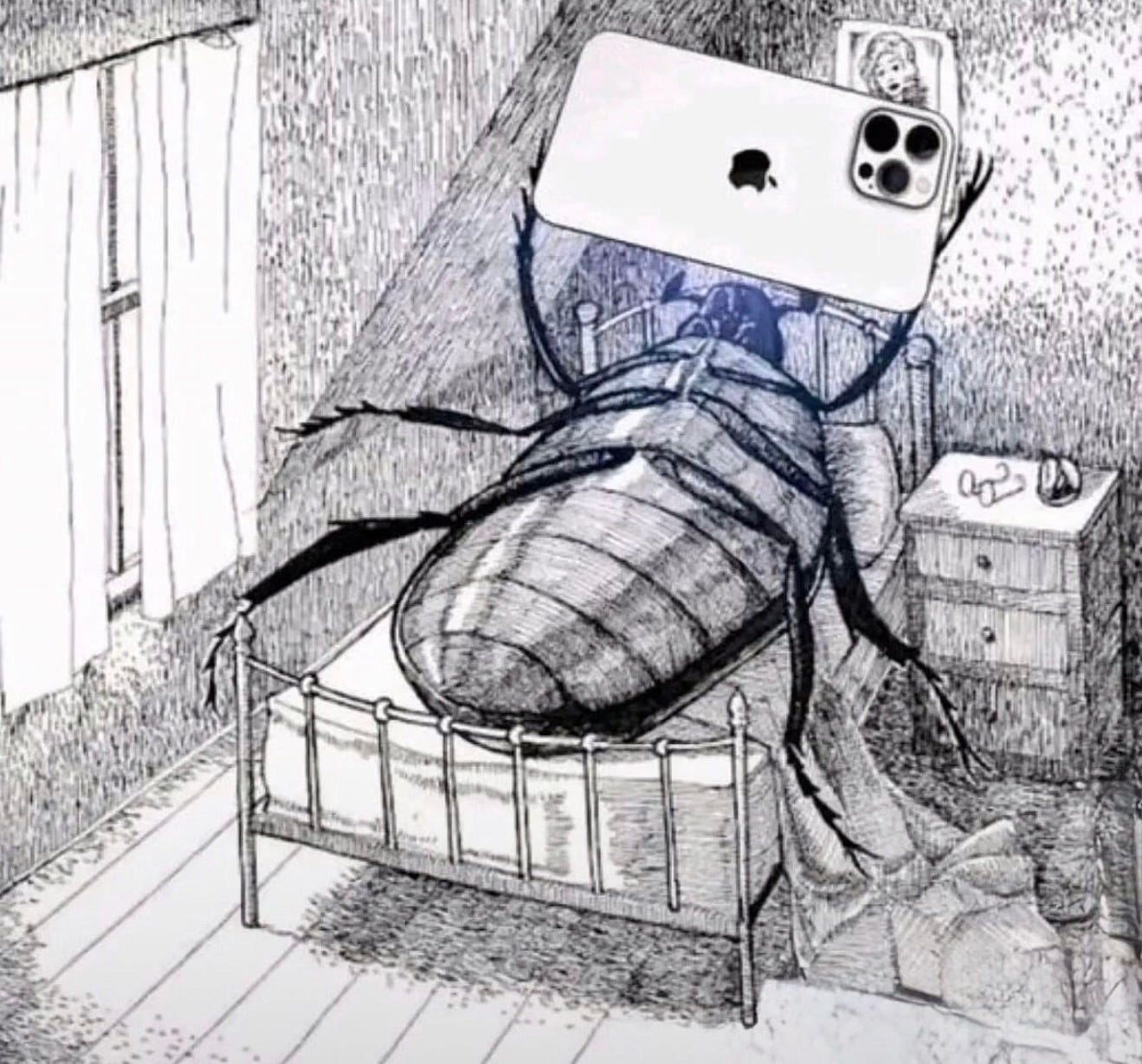
I sit down and try not to look at anyone while, mounted absurdly high on the wall, a TV plays the news with no sound. Closed captions alert us all that we are not allowed to walk in Midtown this evening because the president is going to the Knicks game. The newscaster’s face reflects back in my eyes, which someone might see if my assumption that someone is always looking at me was true, which it isn’t. I put my head down and fold my entire body up and tuck myself into my iPhone, where I do the crossword puzzle. Filling out each clue, I imagine a pixelated and tiny version of my body that lives inside a screen is lifting each letter up like a brick, like the puzzle is grand architecture I am constructing. It is nice to imagine having unlimited strength and endurance, and, of course, being tiny. But it is a Monday so the puzzle is easy and I finish it in minutes (ego trip) so there is my body, planted in the waiting room chair, regular-sized and medically expensive. I had thought the whole getting-diagnosed-with-a-new-illness part of my life was over, that I’d spend the rest of it processing what happened. But now there is something new, almost 4 years after the first diagnostic saga. Plop.
Sitting in the chair, my ego dies without so much as a scream, it just dissipates like a soft, mealy apple under the wheel of a truck. Inside my elbow, a juicy, purple vein throbs. It is like it is trying to talk to me — and it would be quite convenient if it could talk, like if babies and pets could somehow describe their symptoms when they were sick. I wonder if the vein is always so protrusive, or if it just started bulging like this upon arrival at the doctor’s office, a la Pavlov. Pavlov-ing in this context might be advantageous; it is objectively a far worse experience to get blood drawn when a vein is hard to find. But there is a part of me that wants to remind my vein not to get too attached to patterns. Things are always ending, or at least changing, and because my vein is a part of me, I am not confident it will detach gracefully from the familiar.
I get called back to a room (thank God), and before I get the bloodwork done, a nurse I have seen before explains the tests to me. There are so many tubes, she says, because they — she, the other nurses, the doctor, and my other doctors who have all been briefed on the issue but have not yet reached anything resembling a consensus — are checking for everything, leaving no stone unturned. But this also means I won’t hear anything for up to 28 days. All of my blood will be shipped to and processed by a lab in Wisconsin, which I am repeatedly told is the best in the country.
When the nurse leaves the room, the person who will be doing the blood-drawing takes her place. He rolls in a little cart full of needles and tubes, and when I see how many there are, I feel horrible and sick and ashamed of myself for still not having the humility to ask someone to come to my appointments with me, sad that I will have to navigate my fear alone, sad that this fear was predictable and that I made the choice to come alone anyway. I have had a lot of my blood drawn in my life, but this looks undoubtedly like it will be the most yet. I hold out both arms to him, and my elbows hyperextend.
“You have amazing veins,” he tells me.
And so he pierces one and makes small talk while I wrap my other arm under my chin and stare at the wall. I start crying, which is something I might have tried to hide back when I was a newbie to this kind of thing, but now do unabashedly; at this point, I have cried in more doctor’s offices than I haven’t. I have had some great doctors who do their best to assuage my fears, but there is an inherent boundary between myself and anyone else when I am crying, one comfort can’t easily pass through. Mostly because the boundary is my body, and I am stuck in it, and they are not.
The person assures me that while this may be my personal record for Most Blood Taken, it is far from the most blood he has ever drawn from a patient. Even the patient who lost that much blood got up and walked away after, he promises me, and I realize maybe he thinks that my fear is a fear of passing out, which is not what it is. The tubes fill up with red blood.
When the blood-sucking is over, the person gives me a whole box of tissues and pats me on the back. I am grateful for him. At the last practice I went to — the one that referred me here — when I cried in front of the doctor (one of the many times), he kissed my hand and told me that he couldn’t bear to see young ladies cry. We saw each other for almost an entire year. When we first met, he told me there was nothing wrong with me, then he proceeded to diagnose me with something incrementally, saying at first it was minor and then saying it was progressing, and then he said we were all wrong and un-diagnosed me with said thing, then, ultimately, he gave up on my confusing case and sent me here. I welcomed that send-off. So far, this has been, at least, a less-bad experience.
Outside, it is getting hot in New York. The subway ride home is long and sweaty, and I cry a lot during it. I get home and fill out a bunch of blank maps of the United States and the world that my mom printed out for me. I am doing this because I read on Reddit that neuroplasticity is good for you, and before I learn to play an instrument or speak another language, I am trying to tackle geography, a more basic life skill that I am embarrassingly inept at. I try to imagine my brain as a muscle. As a sponge. As a dwindling lightbulb. Then I go for a walk and cry more on a bench in the park, and my vein is still bulging; I think it’s just like that.
-
The post is a carousel of photos of two people in what looks like true love, kissing in the sunshine and having dinner parties in small Brooklyn apartments with a shared group of friends. The photos are not unlike those in my own camera roll. The caption is a long tribute that includes sentiments of: you were the love of my life and I am so angry I have to go on without you and everything I do from now on will be for you. These people are strangers to me.
I hold my phone on my lap and bend my neck in an insane position that will hurt tomorrow, and stare at the screen while I sit on my bed. I cry and cry and cry. I am worried my eye sockets might get too slippery and that my eyes will fall out. Still, I read the comments like a voyeur. I press show more so I don’t miss a single one of them. Then I keep scrolling. The next post is of a similar nature, written by someone who lost both of their parents, and the one after that is written by a teenage boy, a brother who lost his also-teenage sister. Something some people do in their Instagram memorial posts is tag their dead loved one’s account. Unless they are private, I always look, which makes me feel worse, and also like a bad person.
This is a pretty standard showing of the posts my Instagram algorithm suggests. I can’t claim to know exactly how said algorithm impacts me and my self-concept, but obviously, it does not seem good. I had a friend compare it to how people say reading the news damages their mental health, how the constant news cycle — and how so much of it is horrible — bombs our dopamine receptors and breaks our brains. Stay offline, they warned me, which is good advice. But this does not feel like the same problem. In terms of the Instagram memorial posts, I think the main issue is that I identify more with the dead people than with the grievers. I try to think of how these dead people I don’t know feel about leaving their lives behind, and it is the saddest thought I can imagine. Then I try to imagine my loved ones moving on without me; I wonder how attention-seeking I’d be when I haunted them; I ask them in the middle of a normal conversation what they would do if I died right now. My girlfriend said she would either become a monk or create a life-sized yarn doll of me and carry it everywhere. Most people refuse to answer the question. They think I come across as deranged. Maybe. I don’t know if it’s fair to outsource blame for my increasingly warped understanding of my own mortality, but it’s certainly true that every stranger’s Instagram eulogy I read puts diesel in the engine of my horrible health anxiety and familiarizes me with a two-dimensional image of grief that makes my life feel propelled by nothing; people can die in the 24 hours before their latest Instagram story expires.
I find my behavior to be selfish and embarrassing. I try very hard to keep my feet planted in the offline world (aka: the world), to understand my body through being in it, not through projecting it into a metaverse that flattens it and mines it for data. This is where Instagram does its greatest work. Really, the algorithm’s plan is foolproof: feed me content that I am perversely addicted to, deeply afraid of, and ashamed of consuming, watch my eyes become pools, plunge all this content straight through the sockets until it drills associative patterns, or maybe just flat-out holes, into my brain. I have a program that locks me out of my Instagram every 15 minutes; I have to do 1 minute of math problems to get back in. I do the math. I imagine Instagram has a smile like The Joker, unlocking its door and laughing maniacally in my pale, melty face after I just suffered through doing 68x54 in my head to get here.
When my brain is turned on — which it often isn’t while I’m a vessel for Instagram eulogies — I spend a lot of time trying to interpret, maybe diagnose, how technology’s uniformity and social media’s flat immortality (I think of the problematic comments of Love Island contestants that are still alive, unchanged, on corners of the internet waiting for discovery) are convoluting my relationship to my health and body. There is, obviously, a lot to say and a lot that has been said about the damage being online does. Similarly, a lot has been said about self-actualization and self-optimization. There’s a whole belief system that suggests we dig at every thought and feeling we have like we’re breaking down a coded language, like flaws brought on by past incidents motivate every behavior, reaction, pattern. But what I have found to be true in dealing with a chronic illness diagnosis, which is and has been one of the great grieving processes of my life, is that there is nothing to pathologize. Something that felt impossible came true. Other people’s lives sometimes feel impossible, but they aren’t, they could happen to you, too. There is a lyric in a song I listen to when I try to purge out a cry: it’s dumb and I don’t want to learn anything from this.
-
My dear friend who happens to be a medical student comes with me to the doctor’s office. She is an amazing friend for this reason among many others. The doctor talks to me but mainly to her, and makes the appointment like a quiz for her. When I describe a symptom or ask a question, he looks first to her, makes her share her thoughts (as if she hasn’t already told me), and then grades her answer on the spot. It is a strange dynamic and neither of us — my friend nor I — feel great about it, but it is still leagues better than the last doctor. I am sitting on the patient chair watching my friend impress the doctor, and at one point, he jokingly offers her a job.
When he does talk to me, it’s after I bring up a separate (potentially unrelated, potentially related) medical issue — my main medical issue — that I want to make sure he is considering when he determines next steps. At my final appointment with my previous doctor, I asked (again) if he thought said issue might be the reason for this new issue, or at least related to it. He appeared shocked.
You have [X]? he asked. Really? You?
Yes, I said.
Who diagnosed you with that?
A doctor. Well, several doctors.
How does that present on you? I don’t see it at all.
I’m mostly concerned about how it could be related. Do you think it could be?
Huh, he said. Maybe.
So we had gotten no closer to an answer — we hadn’t even set up the right equation — over the course of almost a year. Either he had never written it down, never looked at my chart, or just noticed my crying and thought maybe he should make it worse. If it was the third, it worked. Then, while I was sobbing, looking at the floor, he asked: You don’t have anyone who can come with you to these appointments?
Now, when I bring it up to Doctor #2, he looks markedly less shocked. He asks me when I was diagnosed.
“22,” I say.
“Classic age for that,” he says, and smiles a little.
I nod and do a weird thing with my hand, like a fist or salute or something. He is right: at 22, I was within the age range during which people are most commonly diagnosed with said disease, though definitely near the youngest end.
He smiles a lot.
“I was kidding,” he says.
It takes me a second. Then I get it: this is a joke at my expense. I am an outlier. I am unlucky. I phrased that information like it was normal, commonplace, but I should have made a show of it, or something, gotten dramatic and screamed at the top of my lungs. I was only 22!!!! I am not sure what exactly he wanted me to do.
“Ha,” I say.
Maybe it is the distance from the time I was diagnosed (it’s been about 3 and a half years) or it was the matter-of-fact delivery (I was trying to inform a doctor of information I thought was valuable to them, a transaction which maybe made it seem like I didn’t care or have any emotional stake in it) or it’s the fact that I don’t look sick (not the way you might expect a person with said condition to look sick) that makes him comfortable to joke like that.
But none of that matters when it comes to how I can talk, or how I can be talked to, about being sick. My deliveries are calm and controlled, my reactions random and sporadic. I just turned 26, and I still don’t know how to live with this. I still won’t read the journals I kept at age 22. I still can’t say the diagnosis out loud unless I’m talking to a doctor. When I went to the emergency room last winter, I didn’t let anyone I love come with me because I didn’t want them to overhear me say it.
After the appointment, my friend and I get lunch and talk shit about the collective shortcomings of male doctors, and we talk about other things, too, that are way more fun. We laugh a lot. Recently, I cried in her ear, and she promised me we would get old together; she would make sure of it. I trust her.
The doctor calls me later. I miss the call, and he leaves me a voicemail letting me know he has great news for me if I am interested in hearing it. I call back and he tells me that the diagnosis proposed, made, and unmade by Doctor #1 was ultimately wrong.
“But what about the symptoms?” I ask.
He tells me not to worry. Nothing about me is uncommon in the average young woman.
–
A week after that phone call, new results come into the patient portal. They are confusing and alarming. I call Doctor #2, and he echoes my confusion, and walks back everything he said earlier. These findings make no sense, he tells me, which I have heard before. I refer to myself as a medical mystery. He laughs a little and tells me not to worry; we will figure it out. That we will figure it out is also something I have heard before; Doctor #1 swore it as well. This makes it all seem a bit hopeless, but I make the decision not to lose faith.
Doctor #2 and I schedule another check-in, then we hang up the phone (he has a meeting to get to) and I go for a walk. I do not cry. I do laps around Fort Greene Park, and I wonder if I was a bad person in a past life. If all of it is karma. But I think all it is is just random. Luck. Science. Biology.
The Instagram captions sometimes refer to disease as something their deceased loved one was at war with. For a past job, I interviewed a lot of people who were or had been sick, and wrote articles that were primarily based on public health issues and new medical advancements. A lot of people used language like that: fought, beat. Once, someone who has the same disease as me (without knowing I have it) told me it was something they battled everyday. I hear a similar moral in the support groups I try to go to. Fight back. Resist. Don’t let your body turn your spirit bitter, which is what it is trying to do. Don’t let this define you.
Obviously, I have no critiques for how anyone elects to categorize their chronic illness or how they choose to live with and speak about it. But that kind of language has never felt right for my case. Maybe I can fight off a cold, or a virus, or any other kind of contaminant that threatens my health from the outside and is not a part of me. But chronic illness comes from within. It doesn’t exist without me: it’s not airborne, it’s not floating around waiting for someone to swallow it. Without a body to happen in, it’s just an idea. A term for a process that only a physical body can carry out. A term for something that is happening in my body. I can’t sever it from myself such that it becomes something I should greet with a weapon. Ultimately, I still don’t know what it means to me, but it is a piece of me, for better or for worse. And while I see the merit in “not letting it define me,” and I am very lucky to have a full life that isn’t characterized by woe and illness, being sick does shape me, it has changed me emotionally quite drastically, it has matured me, it has taken a lot from me. I try not to let my ownership of it, our inseparability, convince me that I’m at fault, or make me feel guilty or ashamed.
But guilt and shame still come, and they have played a big role in my hesitation to share my diagnosis; they’re playing a big role now in my hesitation to open up about this current medically mysterious journey I’m on. I prefer to be on the generally optimistic side, and maybe guilt and shame are negative, but I think some of my negativity has been earned. I have had bad experiences trying to unveil this part of myself — the sick part — to others. So I have closed myself up in a clamshell.
It’s easy to characterize not opening up as un-evolved: sharing is beautiful, bonds are created when vulnerability is exchanged, et cetera. But the clamshell offers good protection. It is insulate and private. I don’t know that, before I was sick, I would have predicted I’d be someone who kept their diagnosis a secret. But you can’t predict those things. You learn them. That learning process has tapped me deeper into myself than anything else ever has. It has been very sad. I am under no delusion that it’s over.
Maybe it’s kitschy, but I like the metaphor of the clamshell. It reminds me of being a little kid on the Jersey Shore. Right at the edge of the water, my mom would scoop up handfuls of wet sand and clams — in all their colorful shells — would appear in those small mountains, nibbling their way through the sand to eventually brush and gnaw gently at her hand. They were still mostly shelled, but mobile, and open-mouthed. In my shell, I can still progress — migrate through dense sand towards a warm, open palm.
With the people closest to me, maybe one day I will crack through the shell, and it will be ugly and dramatic. But maybe someday after that, neither of us will remember the shell; I will just be without it, and it won’t live around me like phantom mesh that I’m convinced everyone is always thinking about. For now, I just want them to leave their hands open: don’t ball up fists, don’t reach fingers into the hill to pluck me out and pull me open. I am coming to you. I will come to you. With the right people, every time I inch closer, I grow from it, and our relationship does, too.
In the park, I sit down on a bench and think about texting some people back. They are all, because they don’t know what is going on with me, conversing about other things. I am on edge trying to decide what to do: share how I feel, engage in normal conversation and keep up the pretending it feels like I’m constantly doing, or dramatically leave the group chat in an act of passive aggression and never explain why. So I start crying about it all, and then I cry more because I feel bad for myself for crying, like crying validates how sad it is and then I cry more, reactively, knowing about the sadness, realizing as if for the first time that there is this vast well of sadness in my life.
Then I feel something on me. I twitch and flick it off. As it’s falling, I realize that it is a ladybug. I make a crazy sound. It is kind of like a squawk.
Obviously, I assume that said ladybug is an ancestor or a loved one from beyond the grave who had to traverse the whole world to find me, to get to me, to show me love and support, nuzzle my arm and remind me I am never actually alone, even though sickness can (and often does) feel like the most isolating thing in the world. It had to do all that on its tiny little bug legs! I drop to the ground and move my hands like feral claws through the grass, trying to find the bug, so I can tell it I am sorry I threw you to the ground and also say thank you for finding me and also say I either kind of needed this or really needed it, and mean it. Mostly I just want the bug to come back so I can keep it.
I search and cry hard for a lot of reasons. One of them is disappointment. I am disappointed in myself, in my instinct to push what touches me away, that I pushed it away because I was too distracted looking at my phone, that I was distracted looking at my phone because of emotional turmoil over an illness I don’t want to have, and that I have to live with that illness in the first place. It is so unfair. Another reason is loss.
My hands get dirty. The ladybug is nowhere to be found. There is a deep swell of sadness in my ribcage; it pours out of my nose (gross, I know) and eyes and it drips onto my chin, and I can’t wipe it away because of the dirty hands thing. So it is. I go home because I have to eat dinner. I do a bad drawing of a ladybug dancing on a vein. I tell myself a million times: there will be other bugs. I correctly label all 50 states (ego trip). I go to sleep.
love this